Toggle navigation
Home
About Journal
Journal Purpose
Journal Introduction
Editorial Office Introduction
Included in
Copyright Notice
Editorial Board
Instruction
Subscription
Journal Online
Current Issue
Just Accepted
Archive
Most Read Articles
Most Download Articles
Most Cited Articles
E-mail Alert
RSS
Advertisement
Contact Us
中文
Office Online
Online Submission
Peer Review
Office Work
Editor-in-Chief
Journal Online
Just Accepted
Current Issue
Archive
Advanced Search
Volumn Content
Most Read Articles
Most Download Articles
Most Cited Articles
E-mail Alert
RSS
Journal Information
双月刊,1985年创刊
主管:宝山钢铁股份有限公司
主办:武汉钢铁有限公司
中国金属学会
主编:吴 杰
编辑出版:《炼钢》编辑部
广告经营许可证号:
武市场广登字[2020]2号
邮发代号:38-377
国外发行代号: BM1662
国内连续出版物号:CN 42-1265/TF
国际连续出版物号:ISSN 1002-1043
《炼钢》杂志设有《炼钢》杂志共设置8个栏目:1) 专题论述(特约稿件);2) 铁水预处理(铁水预处理工艺技术及相关技术);3) 转炉及电炉冶炼(转炉、电炉及其它炼钢方法的工艺技术及相关技术);4) 炉外精炼(钢包吹氩、RH、LF、VD、CAS-OB、喂线等工艺技术及相关技术);5) 凝固与浇铸(电渣重熔、模铸、连铸、薄板坯(带)连铸连轧等工艺技术及相关技术);6) 产品工艺及质量控制(不同钢种(包括特钢)的全流程生产工艺开发、质量控制及钢中夹杂物研究等);7) 节能环保(钢渣综合利用、气体回收、负能炼钢等相关技术);8) 其它。
Current Issue
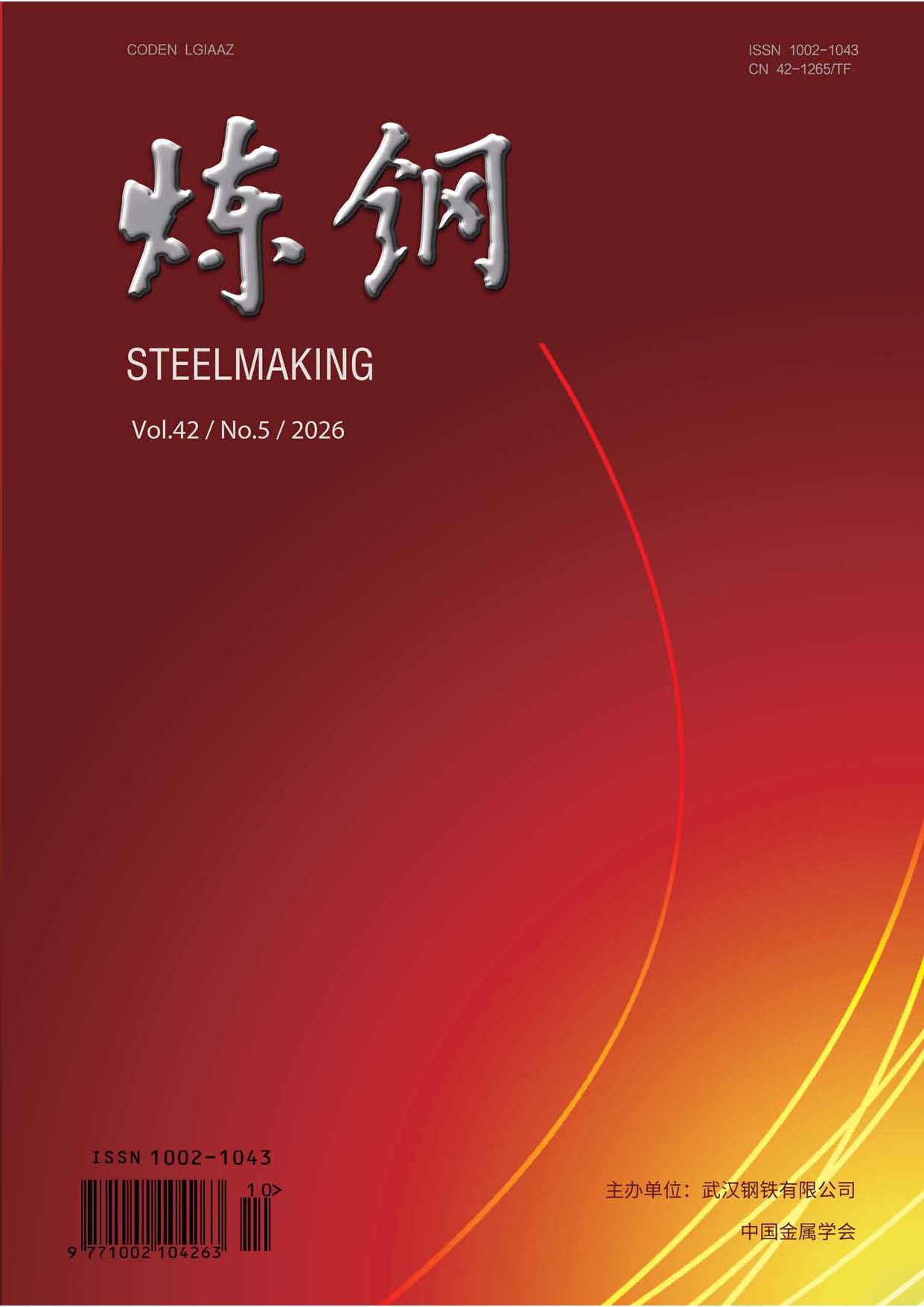
28 September 2026, Volume 42 Issue 5
Previous Issue
Special Topics
Development status of EAF steelmaking and application of rare earth
2026, 42(5): 1-10.
Asbtract
(
8
)
PDF
(1748KB) (
10
)
Related Articles
|
Metrics
In order to explore the application prospect and development trend of rare earth in EAF steelmaking, the current status and existing challenges were systematically reviewed, and the effects of rare earth on inhibiting residual harmful elements, controlling nitrogen content, modifying inclusions and improving product performance were emphatically analyzed. Research indicates that as a typical steel scrap centralized smelting process, green and low-carbon EAF steel faces quality issues such as excessive residual harmful elements, high nitrogen content and excessive inclusions, which have become the major bottleneck restricting its production of high-quality steel. Rare earth elements, with their active chemical properties, low addition amount and remarkable effect, can be used as an ideal additive for enhancing the quality of EAF steel products. In the future, the action mechanism of rare earth in EAF steel should be studied in depth from the micro-scale, the quantitative relationship between rare earth and steel properties should be clarified, the varieties of rare earth steel should be broadened, and the technical obstacles affecting the application of rare earth in EAF steelmaking should be solved, so as to elevate China's technical level of rare earth material manufacturing.
Research progress on scrap melting in high scrap ratio converter steelmaking process
2026, 42(5): 11-24.
Asbtract
(
8
)
PDF
(2122KB) (
10
)
Related Articles
|
Metrics
Increasing the scrap ratio in basic oxygen furnace (BOF) steelmaking is of great significance to carbon emission reduction and the green transformation of China's iron and steel industry. This paper reviews the research progress on scrap melting in BOF steelmaking under high scrap ratio conditions. It summarizes the domestic and overseas status of scrap resource utilization. The process and mechanism of scrap melting in the molten bath are described, and the effects of four key factors, bath temperature, elemental composition, boundary layer characteristics, and scrap properties on scrap melting are analyzed in detail. Key technologies for increasing the scrap ratio, including scrap preheating, in-converter secondary combustion, the addition of supplementary heating agents, and enhanced bath stirring, are summarized as solutions to the issue of insufficient thermal energy. The impacts of high scrap ratios on the BOF steelmaking process are also briefly discussed. Finally, a summary and outlook are provided. This review aims to provide a reference for future research and applications related to high scrap ratio BOF steelmaking.
Hot Metal Pretreatment
Study on formation mechanism and control technology of splash in injection type hot metal ladle
2026, 42(5): 25-31.
Asbtract
(
9
)
PDF
(1367KB) (
6
)
Related Articles
|
Metrics
To control the splash behavior in the desulfurization process of the hot metal ladle with top injection, a water model was established using a 180 t hot metal ladle of a steel plant as a prototype based on the similar principle. The formation mechanism of splashing in a top-blown hot metal ladle was explored, and the effects of the number and diameter of orifices on controlling splashing were investigated. Numerical simulation was used to calculate the gas-liquid two-phase flow behavior in the water model. The results show that the bubbles that rise to the hot metal-slag interface form droplets on the upper surface of their liquid film. Then the gas released by bursting bubbles provides upward momentum to droplets and causes splashing. If the side orifice diameters remain unchanged, converting the two-orifice lance into a three-orifice lance by adding a bottom orifice is not conducive to reduce splash. This is because the addition of a bottom orifice makes the flow rate of the side orifice smaller, so that the initial velocity of bubbles decreases, which leads to poor diffusion of bubbles in the liquid phase and concentration of bubbles near the lance. However, reducing the diameter of the three orifices can increase the initial velocity of the bubbles and enhance their diffusion in the liquid phase. Moreover, it can also decrease the escape velocity of the bubbles at the free surface. When the orifice diameter is reduced from 2.0 mm to 1.6 mm, the splash amount decreases from 27.5 mg to 25.8 mg, indicating that splash is effectively suppressed compared with that of the original two-orifice lance. The optimum orifice diameter of the three-orifice lance in this experiment is 1.8 mm. Industrial trials show that compared with the conventional lance, the three-orifice lance improves the desulfurization rate by 1.2 percentage points and reduces iron loss due to splashing by 5.9 kg/t.
Prediction model of hot metal desulfurizer addition based on IGWO-DNN algorithm
2026, 42(5): 32-42.
Asbtract
(
7
)
PDF
(1908KB) (
2
)
Related Articles
|
Metrics
In order to improve the desulfurization efficiency of KR process in iron and steel smelting process, this paper proposes a prediction model of desulfurizer addition based on improved grey wolf optimization algorithm (IGWO) and deep neural network (DNN). Firstly, the prediction samples were constructed based on the actual production data of the steel plant, and the importance of features was evaluated by random forest (RF). Six process parameters significantly related to the target variable of CaO desulfurizer were selected. Secondly, a good point set strategy and a delayed nonlinear convergence factor are introduced into the standard grey wolf optimization algorithm (GWO) to balance the global exploration and local development capabilities of the algorithm. Finally, IGWO is used to optimize the initial weights and thresholds of DNN, so as to improve the convergence speed and prediction accuracy of the network. The experimental results show that the determination coefficient (R2) of the proposed IGWO-DNN model on the test set reaches 0.93, and the mean absolute error (MAE) and root mean square error (RMSE) are 105.42 and 152.18, respectively. Compared with the traditional model, this method can effectively capture the discrete and fluctuating characteristics in the desulfurization process when dealing with the coupling of complex working conditions and multi-dimensional parameters and significantly improve the adaptability and prediction accuracy of the actual production conditions.
Secondary Refining
Effect of calcium addition amount on transient evolution of inclusions in sulfur-containing steel
2026, 42(5): 43-50.
Asbtract
(
11
)
PDF
(1757KB) (
8
)
Related Articles
|
Metrics
The effect of different calcium contents on the transient evolution of inclusions in sulfur-containing steel was studied by adding silicon calcium alloys to the steel. Under low calcium content conditions, the composition of inclusions changed little, the size and quantity showed an increasing trend and resulting in a lower removal efficiency. Under high calcium content conditions, the decomposition of CaS inclusions was rapid and the removal efficiency of inclusions was high. After 30 min of holding, the number density and area fraction of inclusions in the steel with high and low calcium content were almost the same. Therefore, high calcium content could promote the modification of Al?O? inclusions, generating more liquid and semi-liquid inclusions, while improving the liquid phase fraction of inclusions. Therefore, adopting a higher calcium content process was more conducive to effectively modifying inclusions in sulfur-containing steel and optimizing the liquid window control.
Solidification and Continuous Casting
Research on the influence of molten steel flow in a continuous casting mold on the growth of solidified shell
2026, 42(5): 51-59.
Asbtract
(
9
)
PDF
(1686KB) (
2
)
Related Articles
|
Metrics
During the continuous casting process, the formation and growth of the solidified shell directly determine production safety and product quality, while the flow behavior of molten steel is a critical factor influencing heat transfer during initial solidification and the stability of the solidification front. Therefore, a three-dimensional coupled mathematical model of flow, heat transfer, and solidification in the continuous casting mold was established. The effects of argon flow rate and casting speed on the flow field, temperature distribution, and shell thickness within the mold were systematically simulated. The results indicate that the molten steel exhibits a double-roll flow pattern in the mold. The main jet impinges on the narrow face and forms recirculation flows, leading to significant differences in heat transfer intensity across different regions. At the narrow face, the thickness of the solidified shell and the flow velocity of molten steel at the solidification front show a "first decrease, then increase" trend, demonstrating a clear quantitative correlation. In contrast, at the wide face, due to the upper recirculation flow and intense turbulent mixing near the center, no stable correlation is observed between shell thickness and flow velocity. The findings of this study can provide a theoretical basis for optimizing continuous casting parameters and controlling solidification front stability.
Research on prediction and application of equiaxed grain ratio in the solidification process of high carbon steel billets
2026, 42(5): 60-67.
Asbtract
(
6
)
PDF
(1295KB) (
4
)
Related Articles
|
Metrics
To precisely regulate the solidification structure of continuous casting small billets and improve billet quality, a Columnar-to-Equiaxed Transition (CET) prediction model was established. Taking SWRH82B steel as the reference material, the CET criterion constant for columnar-to-equiaxed transition was determined to be 8.93 ℃·s^1/2·mm^-3/2 under the conditions of a superheat of 27 ℃ and a casting speed of 1.6 m/min. The cooling rate was calculated by measuring the secondary dendrite arm spacing of SWRH77B steel, and the calculated values were compared with the simulated results of the model. The reliability of the mathematical model was verified, with minor errors and consistent variation trends observed. The influence laws of three key process parameters, including superheat, specific water flow rate and casting speed, on the equiaxed grain ratio were further investigated. The results indicated that the equiaxed grain ratio decreased by 1~2 percentage points with every 10 ℃ increase in superheat, decreased by approximately 2 percentage points with every 0.2 L/kg increase in specific water flow rate, and decreased by 1~2 percentage points with every 0.2 m/min rise in casting speed. The research findings provided a theoretical basis and practical guidance for the process optimization of continuous casting small billets and improvement of solidification structure.
Analysis of composition and property changes of Fe-Mn-C high manganese steel continuous casting mold slag
2026, 42(5): 68-75.
Asbtract
(
12
)
PDF
(1595KB) (
8
)
Related Articles
|
Metrics
In the continuous casting process of high-manganese steel, the redox reactions between molten steel and mold slag induce compositional changes in the slag. The infiltration of MnO further drives changes in the slag's properties, rendering the continuous casting process highly unstable. To enhance the sequence casting heats of high-manganese steel and improve the surface quality of continuous casting slabs, this study elaborates on the chemical composition, solidification characteristics, and slag-steel reaction behaviors of the Fe-Mn-C high-manganese wear-resistant steel Mn13, drawing upon the prior research efforts of domestic and international scholars. Through laboratory simulations and theoretical analyses, the reaction behavior and stability of MnO in continuous casting mold slag were investigated. Experimental results indicate that for Fe-Mn-C high-manganese steel utilizing CaO-SiO?-based mold slag, as the slag-steel reaction proceeds, the SiO? content in the slag decreases while the MnO content rises rapidly; concurrently, the Si content in the steel increases whereas the Mn content declines. Notably, the initial dosage of MnO incorporated into the mold slag exhibits no inhibitory effect on the reaction. As the MnO content in the slag gradually increases during the reaction, both the viscosity and break temperature of the slag decrease progressively. The reduced break temperature extends the duration of the liquid slag film, thereby improving the lubrication between the mold and the cast slab. These findings can provide crucial technical support for the continuous casting production of Fe-Mn-C high-manganese steel.
Product Process and Quality Control
Study on the effect of cerium on inclusion modification and properties of 201-J5 stainless steel
2026, 42(5): 76-85.
Asbtract
(
6
)
PDF
(1819KB) (
3
)
Related Articles
|
Metrics
Based on industrial experiments, the modification effect of Ce content on inclusions in 201-J5 low nickel austenitic stainless steel and its influence on corrosion resistance and mechanical properties were systematically studied. As the Ce mass fraction increased from 0 to 61×10??, the inclusions in the steel gradually transformed from Al-Si-Mn-Ca-O and MnS to spherical Ce-Al-Si-O-S composite inclusions. The number density of inclusions decreased from 28.9 mm?2 to 16.2 mm?2, the area fraction decreased from 68.9×10?? to 39.8×10??, and the average size decreased from 4.9 μm to 4.4 μm. When the Ce mass fraction was 37×10??, the stainless steel exhibited the best corrosion resistance. When the Ce mass fraction increased from 0 to 37×10??, the corrosion weight loss rate of steel decreased from 0.078 g/(m2·d) to 0.038 g/(m2·d), and the breakdown potential increased from 128.1 mV to 147.6 mV, and the intergranular corrosion susceptibility was significantly reduced. In terms of mechanical properties, the addition of the rare earth element Ce refined the grain structure, increasing the grain size level from 6.0 to 6.6. Simultaneously, the tensile properties and impact toughness of the steel were improved, with the transverse tensile strength showing an increasing and then decreasing trend, the longitudinal tensile strength continuously increased, and the elongation after fracture steadily increased. The impact absorption energy reached a peak of 102 J at a Ce mass fraction of 34×10??. In addition, Ce effectively improved the high-temperature plasticity of the steel, eliminated the plastic deterioration phenomenon in the 1100–1150 ℃, and effectively suppressed the occurrence of peeling defects on the surface of hot-rolled plates. This study provides an important basis for the inclusion control and performance improvement of rare earth Ce in the industrial application of low nickel austenitic stainless steel.
Characterization and origin analysis of coarse carbonitrides leading to inadequate HIC resistance in X65MS pipeline steel
2026, 42(5): 86-94.
Asbtract
(
11
)
PDF
(1639KB) (
5
)
Related Articles
|
Metrics
The causes of inadequate resistance to hydrogen-induced cracking (HIC) in X65MS pipeline steel were systematically investigated. By correlating the findings with the distribution characteristics of carbonitrides in the continuous casting slab, it clearly revealed the evolution process and underlying mechanism of "casting segregation → formation of precipitates and detrimental microstructures → initiation of hydrogen-induced cracks". The experimental results demonstrated that the enrichment of solute elements such as Nb, Ti, C, and N in the centerline segregation zone of the slab provided the driving force for the precipitation and growth of coarse carbonitrides. These coarse carbonitrides were inherited into the steel plates, acting as irreversible hydrogen traps that promoted HIC nucleation and propagated along the banded hard/brittle microstructure induced by casting segregation. Thermodynamic calculations indicated that the onset precipitation temperature of TiN was approximately 1479.0 ℃, close to the solidus temperature, suggesting its initial precipitation in the liquid or interdendritic regions during the final stage of solidification. In contrast, the onset precipitation temperature of NbC was about 1134 ℃, indicating its propensity to precipitate in the slab core where the defect density was high. By precisely adjusting the contents of key elements such as Ti, N, and Nb, the precipitation temperature and amount of carbonitrides could be actively controlled. To improve the HIC resistance of X65MS pipeline steel, the following integrated measures are recommended. During continuous casting, adopt low casting speed and low superheat combined with enhanced soft reduction to alleviate centerline segregation; during rolling, control appropriate reheating temperature and deformation in the non-recrystallization region, and optimize cooling procedures to refine the microstructure and suppress harmful precipitates. Meanwhile, nitrogen content should be strictly controlled, and Ti/Nb contents may be appropriately reduced. Through coordinated regulation across the entire process route, the HIC resistance of the steel is expected to be improved, providing a valuable reference for industrial production.
Study on titanium nitride inclusions in continuous casting slabs
2026, 42(5): 95-103.
Asbtract
(
6
)
PDF
(1501KB) (
9
)
Related Articles
|
Metrics
Large TiN inclusions were found in the hot-rolled medium carbon steel plates with titanium microalloying. Therefore, the slab of titanium microalloyed medium carbon steel was taken as the research object. The TiN inclusions in slab were observed by means of optical microscope (OM), scanning electron microscope (SEM), ASPEX, stereomicroscope (ST), and microhardness tester (MH), and the distribution law of TiN inclusions in the thickness direction of the slab was summarized. An innovative combination of micro-labeling and dendrite erosion was adopted to confirm that the large-grained titanium nitride in slab was precipitated between dendrites. The three-dimensional morphology of TiN inclusions in slab was observed by large sample electrolysis, and it was proved that with the increase of TiN particle size, the morphology presented dendritic, confirming that the large TiN inclusions grew in a dendritic manner. The TiN inclusions obtained by ultrasonic cleaning and electrolysis were found to be fragile. Chain-like TiN inclusions were found in the rolled products, verifying that the TiN inclusions in the dendritic state in slab were broken into chains during the rolling deformation process. The TiN in slab of the studied steel was marked, and the heating furnace process was simulated, proving that under the existing heating furnace process conditions, the TiN inclusions were difficult to dissolve.
Energy Conservation and Environmental Protection
Study on the characteristics and formation mechanism of nodule in converter dry de-dusting flue
2026, 42(5): 104-114.
Asbtract
(
8
)
PDF
(2305KB) (
8
)
Related Articles
|
Metrics
In response to the problem of nodule in the converter dry de-dusting flue, the characteristics of nodule were analyzed by XRF, XRD, SEM and other equipment, and the formation mechanism of nodule was analyzed in combination with thermodynamic calculation. The study shows that the nodule phenomenon in the converter dry de-dusting flue is mainly concentrated in the flue hood, the sloping area of the vaporization cooling flue, the end of the vaporization cooling flue, the evaporative cooler interior and banana bend area, and the reasons for the nodule include physical nodule and chemical nodule. Metal splashing in the initial stage of blowing is the main cause of nodule on the flue hood. The presence of a large amount of CaO and the basic oxides Fe?O? in the dust undergoes high-temperature reactions to form CaFe?O?, which is the primary cause of the formation of nodule in the sloping area of the vaporization cooling flue. The high-temperature reaction of ZnO with Fe?O? in the fly ash to form ZnFe?O? is the main reason for nodule at the end of the flue and inside the evaporative cooler, and CaO in the dust reacts with CO? in flue gas to form CaCO?, which will aggravate the nodule inside the evaporative cooler. The flue gas contains a large amount of NaCl and KCl, which are low-melting substances that can cause the size of the nodule in the flue to increase and their strength to augment.
News
fdas fda fdsewf fewf vcgre gbtr trhf fdsfew fewfds fdsfdsaf fdsaf dsa fds fdsa
2020-07-06
test1test1test1test1test1test1test1
2020-07-06
More>>
Download
More>>
Links
More>>
Visited
Total visitors:
Visitors of today:
Now online: